

Framework conditions
Complex, multi-stage examination process with diverse information sources

Goal
Time savings in the examination process for trademarks to be protected

Solution
RAG-based assistance system that supports decision-making by identifying relevant information.
Initial situation
The Swiss Federal Institute of Intellectual Property (IGE | IPI) is Switzerland’s central federal authority for patents, trademarks, design protection, protected geographical indications, and copyright. Its employees ensure the correct registration and protection of trademark rights on a daily basis.
This multi-stage, highly complex examination process involves a large number of steps and determines whether a trademark or its components are already protected or eligible for protection. To this end, employees have access to countless documents (e.g. the Nice Classification, international agreements, etc.).

The individual information sources have different weightings in the decision-making process. For example, international agreements and laws carry more weight than reference cases relating to individual trademark claims. The examination is carried out using proprietary software in which all documents supporting the examination are searchable. Depending on experience and framework conditions, the trademark examination process can be very time-consuming, as all relevant information must be researched and compiled.
Goal
The IGE approached eoda to launch an innovative pilot project: a RAG-based AI assistance system integrated into the trademark examination support process.
The IGE aims to simplify the complex examination process and relieve the specialist department. In addition to automated support, the IGE wants to use the pilot project to gain experience in working with AI systems and to assess the technical feasibility of such solutions for its own use cases.
RAG (Retrieval-Augmented Generation) is a method for improving the quality of language model responses. Instead of relying solely on its training data, RAG draws on external, up-to-date information. To do so, relevant data sources are searched (retrieval) and the prompt is augmented with the information found (augmentation). This enables the model to generate (generation) well-founded and current responses and to avoid so-called “hallucinations” (fabricated false information).
What advantages does this approach offer when using language models in an enterprise context?
Challenge
In addition to the complexity of the examination process, aspects of data security and the protection of intellectual property must also be taken into account: the IGE’s data basis contains sensitive information, which is why an on-premises implementation was preferred so that no data is shared externally. Local deployment places particular demands on the language models used, as the available on-site GPU capacity is a limiting factor.
Solution
In the previous examination process to determine whether a trademark can be protected, the term to be protected must be laboriously checked against the documents mentioned above. To do this, examiners have to compare the term and relevant components of the term with similar terms. In addition, the term must be reviewed with regard to geographical indications, applicable laws and agreements, or previously issued similar decisions – always taking into account the similarity of the relevant Nice classifications (e.g. Class 30: “coffee, tea, cocoa, rice, spices”). All of this is carried out through the manual selection of the respective sources.
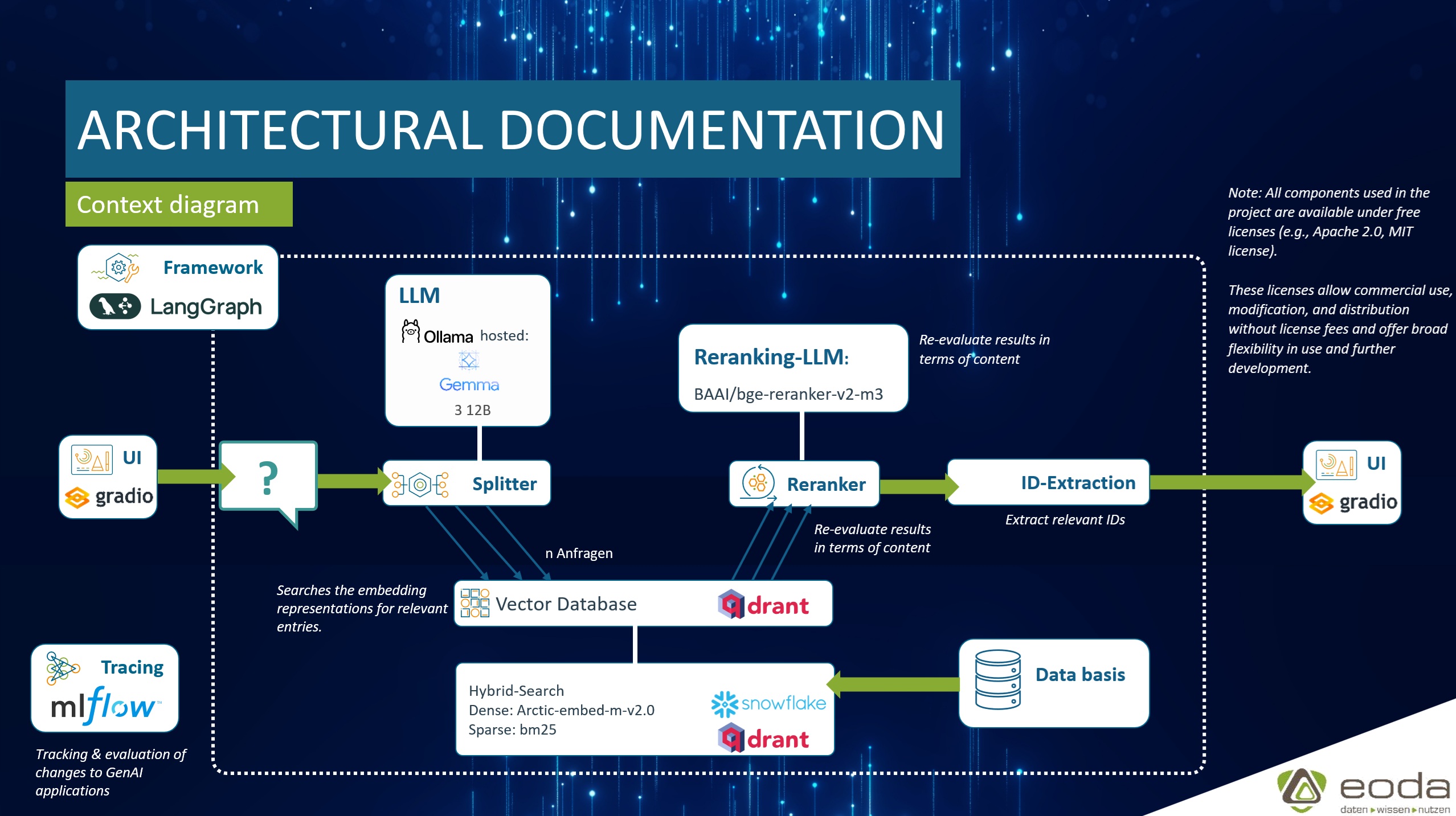
As part of the project, eoda developed a local RAG pipeline including a graphical user interface to enable easy querying of the documents that are important for decision-making.
After entering the search term (the trademark to be examined), it is split by a language model. Both the individual word components and the complete term are forwarded to a vector database and checked using hybrid search. The vector database contains the data basis, i.e. the documents mentioned above. The results (document IDs) of the hybrid search are then sorted and filtered according to their relevance for the decision using another language model (reranking). A key aspect of complex projects is the appropriate composition of system components in order to achieve an optimal balance between performance (e.g. response time) and result quality.
Our more than 15 years of practical experience show that an iterative, agile approach is the most promising for complex use cases, as there is no universal set of components that reliably delivers optimal results in every configuration for every use case. Instead, each use case requires individual fine-tuning and the selection of the most suitable building blocks. Through agile adjustment and the continuous identification of the most appropriate system components (LLMs, vector databases, alternative steps, prompts, etc.), it is always possible to find the best possible combination even in on-premises deployments. All components used in the project are available under open-source licenses (e.g. Apache 2.0, MIT License). These licenses allow commercial use, modification, and distribution without license fees and offer a high degree of flexibility in terms of deployment, further development, and independence from commercial vendors.
Result
Shortly after the project began, the assistance system was already able to deliver reliable results that confirmed both the technical feasibility and the suitability of the “trademark examination” use case for the application of artificial intelligence.
This AI project for the IGE demonstrates the great potential of AI as a support for experts—even in a highly complex and sensitive environment such as trademark examination. The key lies in the sensible combination of reliable AI-based automation of time-consuming routine processes and human expertise.
Insgesamt trägt das Projekt wesentlich dazu bei, das Vertrauen in die Technologie zu stärken, interne Stakeholder zu überzeugen und die strategische Relevanz des KI-Einsatzes im Unternehmen zu untermauern. Dies stellt einen wichtigen Meilenstein für den nachhaltigen Projekterfolg dar.
“This project marks a significant step forward for us. The collaboration with eoda was characterized by genuine team spirit, technical expertise, and initiative. From the very beginning, we felt understood—both as a team and in terms of our use case. Thanks to the project and to eoda, we have gained valuable experience for the future use of artificial intelligence, developed a deeper understanding of our data foundation, and are looking forward to the future.”
Susanne Wenger | Project Lead & Subject Matter Expert for ICT Architecture | Swiss Federal Institute of Intellectual Property IPI
Get started now:
We look forward to exchanging ideas with you.

Your expert on AI strategy:
Dr. Martin Bober
empowerment@eoda.de
Tel. +49 561 87948-370