

Data
High-frequency measurement data (fault records, transient measurement data, etc.) from nationwide distributed locations within the energy grid.

Toolset
Use of a fast-response database, development of intelligent ETL pipelines and algorithms for anomaly detection, web-based data visualization and data provision.

Solution
Development of a highly scalable data platform based on a data science project platform developed by eoda for the aggregation, processing, analysis and visualization of measurement data from Deutsche Bahn's traction current network.
As a subsidiary of DB AG, DB Energie GmbH manages the 16.7 Hz energy grid for the energy supply of trains, railroad facilities and real estate. The traction current network extends over 7,900 km. In order to keep the grid as stable as possible even in the event of overvoltages, short circuits or distortions in voltages and currents, various measuring points are used which are activated in the event of a fault.

Challenge
The system landscape of the measuring points in use and therefore the monitoring of the network itself is very heterogeneous. For example, measuring devices from various manufacturers are used, some of which have been in use for many years. Furthermore, the connection of the locations poses a challenge, as some of the measuring points have a low bandwidth. Since the measurement of transient data with a sampling rate of 20 kHz results in 18 million measured values within 15 minutes, a timely download is very difficult due to the data size. This means that in the event of faults or anomalies within the energy network, it is often only possible to investigate the cause with a delay. This in turn makes it more difficult to take appropriate measures, such as replacing components.
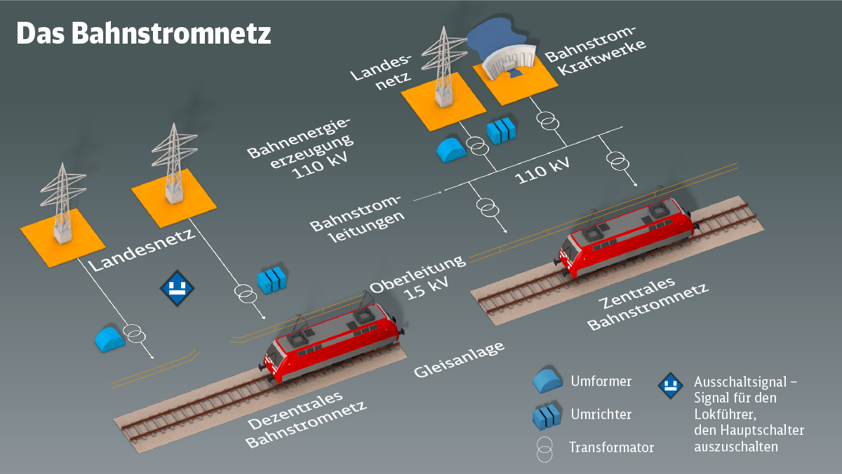
The system landscape of the measuring points in use and therefore the monitoring of the network itself is very heterogeneous. For example, measuring devices from various manufacturers are used, some of which have been in use for many years. Furthermore, the connection of the locations poses a challenge, as some of the measuring points have a low bandwidth. Since the measurement of transient data with a sampling rate of 20 kHz results in 18 million measured values within 15 minutes, a timely download is very difficult due to the data size.
This means that in the event of faults or anomalies within the energy network, it is often only possible to investigate the cause with a delay. This in turn makes it more difficult to take appropriate measures, such as replacing components.
Goal
In order to be able to react as quickly as possible in the event of a disruption and thus ensure disruption-free rail traffic, DB Energie GmbH requires a flexible and highly scalable measurement data platform that retrieves and centrally stores the data from various measuring points. This data is to be used to identify, reconstruct and subsequently simulate disruptions so that suitable measures can be taken as quickly as possible.
At the same time, the trained specialist staff at DB Energie GmbH should be able to analyze the available measurement data promptly in order to identify consumption patterns, faults and anomalies. Automated detection with active notification of the specialist staff also supports this process by actively notifying them during automated detection. This information and knowledge should also form the basis for site-specific modifications and specifications. For example, the need for new network components and other parts can be derived from this information.
The new measurement data platform should also solve the challenge of local data storage through reliable archiving, as well as subsequent restoration.
To summarize:
The new measurement data platform should fulfill the following tasks:
Recording, compiling and visualizing measurement data on relevant faults and the grid status.
Analyzing the fault recordings and forwarding the data to the downstream grid simulation.
Data-based foundation for validation and development of countermeasures in the event of systematic faults.
Solution
DB Energie GmbH is relying on its project partners VIVAVIS AG, Systema and eoda to implement the new measurement data platform. The joint project benefits from the expertise of all those involved: eoda with over 10 years of project experience in the field of artificial intelligence and data infrastructures. VIVAVIS AG with its experience in the field of digital requirements in the energy and utilities industry. Systema with its expertise in setting up and operating critical infrastructures.
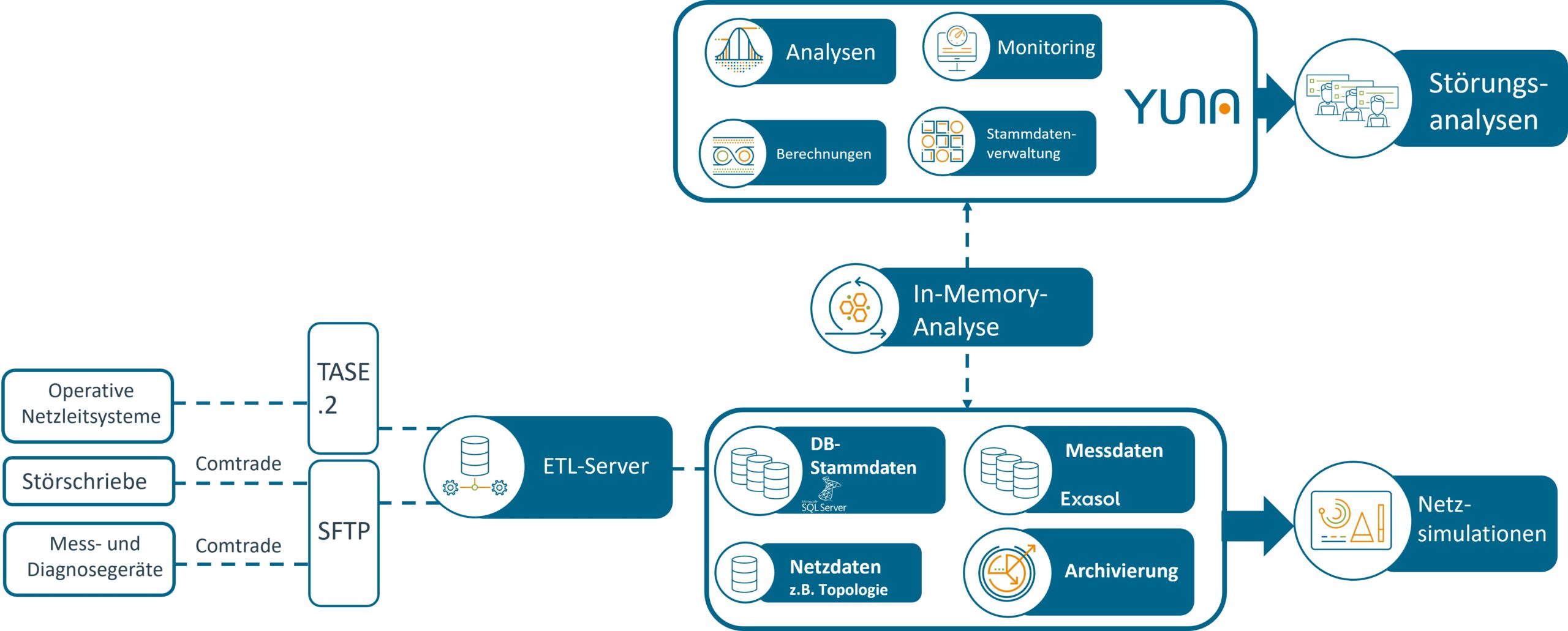
Together with the project partners, eoda developed configurable solutions in the specification phase and then implemented them in order to realize data extraction, data processing, analytics and visualization of measurement data:
- Implementation and operation of a highly scalable Exasol database.
- Development of ETL pipelines and algorithms for data extraction from the measuring points, aggregation and transformation of the measurement data and execution of the analyses as well as the development of models for anomaly detection.
- The data science project platform developed by eoda was used as the technical basis. The measurement data platform played a central role in the execution and management of analysis scripts and data visualization. It is the basic tool for users.
- Setting up a separate backup server to ensure availability/obligation to retain data for several years.
The use of an Exasol database offers a decisive advantage: scripts can already be executed in the database using R code. This means that the initial data processing and preparation is carried out using a fast Fourier transformation (FT). A traceable time series of around 50 values is created from 18 million individual measured values.
The results of the FFT are then visualized in the measurement data platform. Further scripts developed by eoda are used for calculations in the measurement data platform, including
- Harmonic analysis
- Power calculation
- Impedance curves in the harmonic spectrum
- Averaging
- Gradient formation
It was also made possible for DB Energie GmbH specialists to integrate additional R scripts into the measurement data platform, e.g. for pattern and anomaly detection.
In addition, the time series can be further summarized or compared with each other or further data transformations and analyses can be carried out using the drag n' drop function for better verification - network faults can thus be quickly identified. In addition, separate measured values can be added to the system or the corresponding time series exported using import functions.
The data extraction can be started via a trigger by the network control system. All parameterized and available measurement and fault recordings in the periphery around the selected fault locations are collected and bundled.
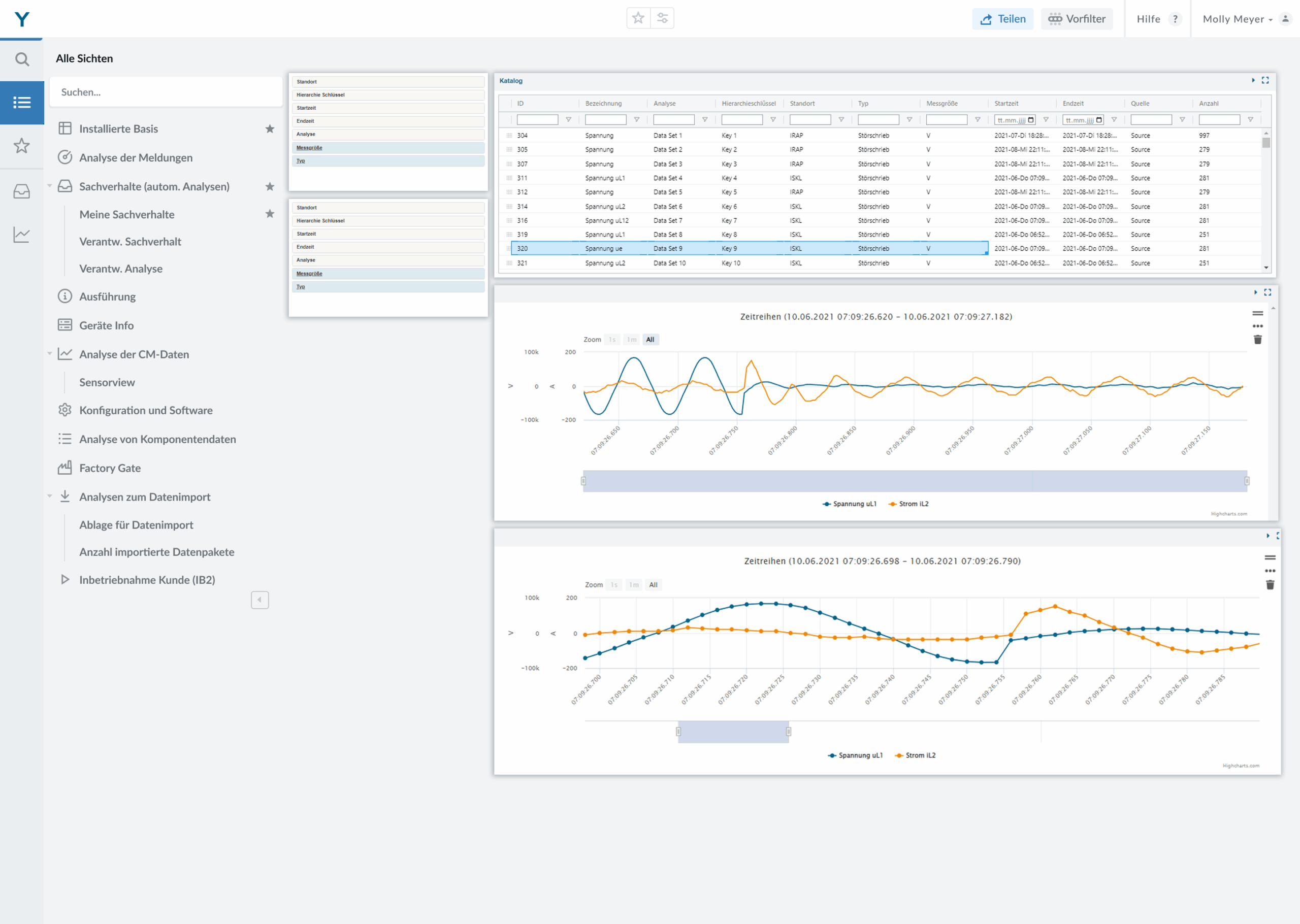
The (compiled) analysis results and the underlying data can also be transferred directly to the backup server. From there, all results and data can be subsequently restored within the retention period. This enables subsequent and complete transparency and traceability, even at a later date.
Result
With the metering data platform developed by eoda and the project partners, DB Energie GmbH will be able to respond more quickly and effectively to grid fluctuations and disruptions.
By using the data science project platform developed by eoda as the technical foundation, eoda was able to meet various metering data platform requirements very early on in the project. This platform covers most of the application functions, data visualization, script execution, and management right from the start. Thanks to its modular structure, the metering data platform can also be expanded over the long term and can thus be used as a starting point for future analytical initiatives.
Together with the implementation of intelligent ETL pipelines, the metering data platform solves the challenges of decentralized data distribution and data storage. This enables the rapid analysis of metering data from various nodes within the network, which would have been only possible to a limited extent using traditional methods due to the volume of data.
The measurement data platform is therefore an important component of DB Energie GmbH’s energy management and ensures reliable supply in the long term.
Get started now:
We look forward to exchanging ideas with you.

Your expert on Data-Science-Projects:
Manfred Menze
projects@eoda.de
Tel. +49 561 87948-370
